
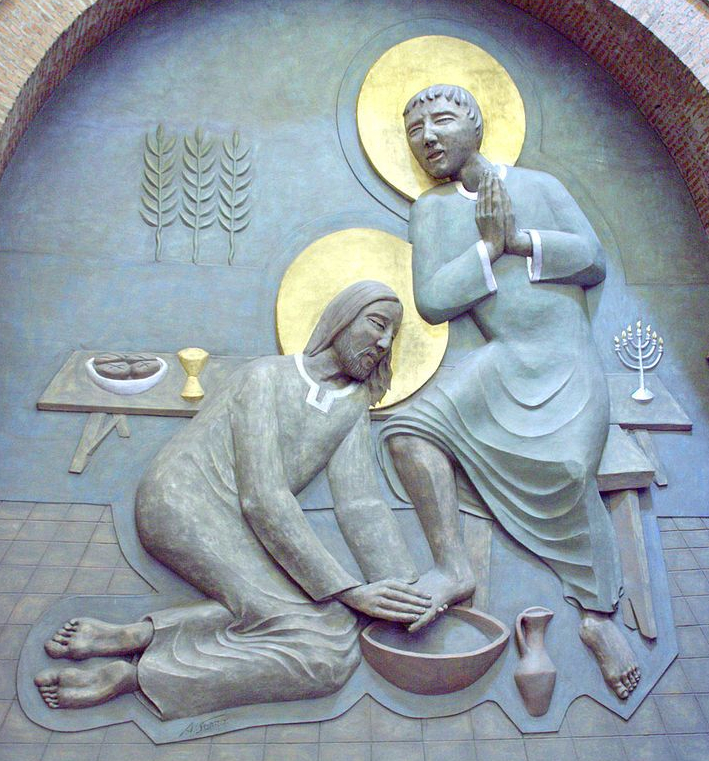
 By © José Luiz Bernardes Ribeiro, CC BY-SA 4.0, https://commons.wikimedia.org/w/index.php?curid=37317306
“By this everyone will know that you are my disciples” – John 13:35a
The love of God in Christ Jesus makes no distinction. It knows no boundaries or borders. We have heard it so many times that some might roll their eyes way back and even declare it cheesy. I beg to differ. This love is indeed universal and never irrelevant. Perhaps now even more critical than it has been at other times.
The premise of indiscriminate love, one that reaches every corner, every people, and permeates through any difference, to restore things thought of being beyond repair, may take a lifetime to accept. However, the power of such a premise, Love universal, is active as we speak and doing what it suppose to do while some us still stumble and struggle in the shore.
How do we jump into this boat? Enter Maundy Thursday.
There is something from last weekend Liturgy of Palms that resonates with the foot washing scene that we hear in every Maundy (short for mandate) Thursday. Luke’s Passion narrative tells us that a dispute arose after the Last Supper:
A dispute also arose among them as to which one of them was to be regarded as the greatest. But he said to them, “The kings of the Gentiles lord it over them; and those in authority over them are called benefactors. But not so with you; rather the greatest among you must become like the youngest, and the leader like one who serves. For who is greater, the one who is at the table or the one who serves? Is it not the one at the table? But I am among you as one who serves. (Luke 22:24-27)
John does not describe the Last Supper as the other evangelists do. However, he says that during their Passover meal, which is code word for Jesus last meal with the disciples, Jesus got up and wash their feet. Therefore, here in John, not only Jesus is the one who serves the meal, but also one that does something else that would be outrageous for his disciples. Jesus washes their feet, a duty reserved for the lowest of slaves. When he is done, he goes on to say:
So if I, your Lord and Teacher, have washed your feet, you also ought to wash one another’s feet. For I have set you an example, that you also should do as I have done to you. (John 13: 14-15)
The theme that says that the believer must place oneself in a lower position in relation to others is as recurrent in the gospels as the Christian faithful rejects it. That is because we are seldom taught to play to lose in order to win. Nonetheless, at the same time, this is something that Jesus tells us so many times in so many different ways! We can only guess that this is as important to him as it is mind-boggling to us. Lose so you may gain.
John takes this established notion and put to us in a vivid image. There are actually two mandates from Jesus mandate in our Maundy Thursday gospel. The first is that we “ought to wash one another’s feet.” It is not an exchange of favors. Jesus reminds us that our Lord, Teacher, Savior, and Christ, did what no one would do voluntarily, what only the lowest of the lowly would do. It is not a quid pro quo. Jesus did not wash the disciples’ feet so they would own something back to him. There is nothing one can give to God that God does not already have. Instead, the example he gave, and the one he mandates us to follow is this: do not do to others so you may gain power. Do for others what no one else would do for them.
Perhaps it is not by coincidence that Jesus gives us the mandate of humble service to each other before commanding us to love one another as he loves us. Could be focusing our efforts, resources, and talents to uplift others and not ourselves, the key to experiencing the joy and the restoration brought about only by love universal?
…
Readings for Maundy Thursday
Exodus 12:1-4 [5-10] 11-14
Psalm 116:1-2, 12-19
1 Corinthians 11:23-26
John 13:1-17, 31b-35
 Bridging Faith