
The people called by God, out of slavery into freedom, to become a city on a hill, and a light for all the nations (Isaiah 42:6; 49:6; Matthew 5:16) have always faced a tough choice between such call and the safety of their own. It is a slippery slope that long precedes our time.
The prophet Amos writes from a time when at least some among God’s people seemed to have experienced prosperity and abundance. Items made of ivory (Amos 3:15) and houses built of ashlar masonry, or hew stone (Amos 5:11), are found in the archeological record of the ancient Palestine during the reigns of Jeroboam II in the northern kingdom of Israel and Uzziah in the southern Kingdom of Judah (Amos 1:1). This is a period of military peace when neither the Egyptians in the South nor the Assyrians in the north represented a serious threat to the Israelites. Judah and Israel were then able to collaborate to control the trade routes through Palestine leading to an increase in wealth.[1] There is when Amos beef started.
It can be argued that Amos strong criticism towards the prosperous among God’s people had little to do with their acquired wealth and power and a lot to do with how it was directed, or not, towards God’s purposes of justice and freedom for all. The abundance and security that some experienced may have led to the perception that God was pleased with the people and supported the way they did things. It became necessary to protect their self-perceived righteousness and way of life at any cost. The quote below explains well what inspired Amos to interfere and testify in God’s name:
“Israel viewed themselves as the elect of God, chosen by Yahweh to be His people, His nation; and they considered that election as an occasion of privilege and prosperity. Yet, for Amos, the people had turned the doctrine of election upside down. Election meant, first and foremost, special responsibility and obligation, which Israel could discharge only through the proper treatment of their fellow human beings. Amos measured the moral health of Israel and found the country fatally ill. Amid the peace, prosperity, and religious enthusiasm there was no fundamental loyalty to God, social justice, and ethical standards. Amos declared that God had thus rejected Israel’s corrupt cult (Amos 5:21–24)”[2]
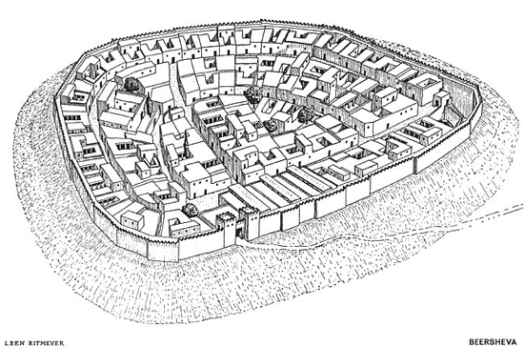
The prophet’s critique of God’s people extended to their practices in the “gate” (Amos 5:15). It was typical for towns to have a wall, which protected them from the dangers, military and otherwise, which were “out there” in the wilderness. This wall would have only a couple, if not just one, fortified points of entry which would be called the gate (see the picture of Beersheba, one of the main towns at the northern Kingdom of Israel during the time of prophet Amos). The city gates, therefore, became the natural location for the marketplaces to develop due to the higher foot traffic and the usual concentration of security forces. There was the place where the need for safety met God’s mission of hospitality and justice to others. There, the poor and the aliens were to be treated with the same hospitality and generosity that the people liberated and called were to extend to one another (Leviticus 19:33). There, the needy were not to be pushed aside by self-centered evil practices. Furthermore, Amos proclaimed that the renouncing of those practices was the measure by which God’s people would continue to find peace and security.
Now in our time, the people called still face the same tough choice where the civil obligation to protect our own and our resources with borders, fences, or walls meets our call to continue to let our light so shine before others so that the whole world can see that we are disciples of Jesus Christ. In this time and place, God still calls us to practice justice in our gates and in our marketplaces. The ethical question that remains for us Christians and our elected leaders is such: how we protect our own lives and at the same time bring about good news to the poor, release to the captives, health care to the sick, and the same freedom that we enjoy to those who are oppressed and don’t have it? Pushing aside in the gates the ones who need what we are called to assist with is not an option.
In Christ, Pastor Mauricio.
[1] The Anchor Yale Bible Dictionary, 1992; Amos, The book of; page 205.
[2] Same; page 206.
 Bridging Faith